
Steel Fabrication
Steel fabrication work in Pakistan covering MS and SS fabrication, storage tanks, steel structures, prefabricated sheds and site erection. In house workshop, nationwide delivery and installation.
MS & SS Work
In-House Fabrication
Built to Drawing
Or We Measure
Nationwide
Delivery & Erection
Coded Welding
Inspected Joints
The Challenge
Send us your drawings and we quote from them. If you do not have drawings, we take the measurements ourselves.
One firm cuts and welds. A transporter delivers. A third crew erects on site. Each one signs off its own part, and when something does not fit, nobody owns it.
The argument is always the same. The fabricator says the steel left the shop to drawing. The erector says it arrived out of square. The transporter says it was loaded that way. Meanwhile your site is stopped and the crane hired for the lift is standing idle on hourly charges.
Holes that do not line up get reamed on site by a man with a grinder. That is not a repair. It removes section from a connection that was calculated, and it is done at height with no record of what was cut.
Workshop conditions and site conditions are not the same, and the gap shows in the welding.
In the shop the joint is positioned flat, the piece is clamped, the operator is on a bench and the work is inspected before it leaves. On site the same joint is overhead, in wind, on a scaffold, in Multan heat, with the welder holding position. AWS D1.1, the structural welding code for steel, sets requirements for design, welding procedures, welder qualification, fabrication and inspection, and it applies equally to both. In practice, the shop weld is easier to get right.
The answer is to move as much work into the workshop as the transport allows, and to plan the site joints deliberately rather than leaving them to whatever fits on the lorry.
Site work also carries duties you cannot subcontract away. The Punjab Occupational Safety and Health Act 2019 covers scaffolding and work at height, protective equipment, and the use and handling of cranes, hoists and lifting operations, and places general duties on the employer for everyone on the site.
What We Supply
Storage tank fabrication for water, chemical, fuel and process storage, shop built or erected on site depending on diameter.
Steel structure fabrication covering columns, beams, trusses, platforms, walkways, staircases and crane support structures.
Prefabricated sheds and buildings where the frame and cladding are made in the workshop and bolted together on your plot.
Industrial building construction for a serviced building rather than a bare shell.
Blast proof gates for sites where the entrance has to resist an explosive load.
We also handle overhead crane manufacturing in the same workshop, which is why crane support steel and the crane itself can come from one supplier.
How It Works
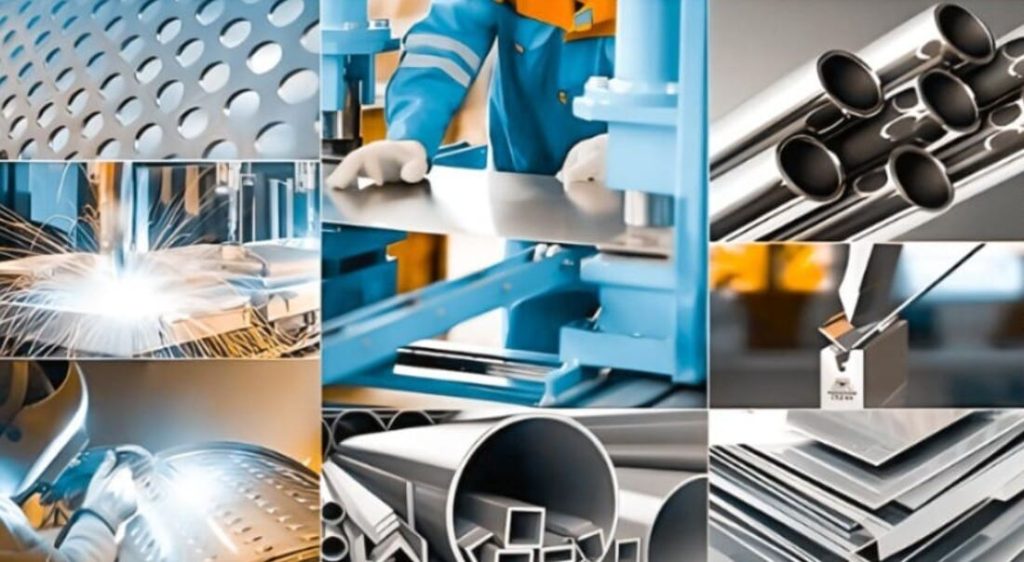
Cutting, drilling, bending, rolling and forming for shaping. Welding, grinding, machining and assembly for joining and finishing.
Surface preparation is where most jobs are won or lost. ISO 8501-1 sets the rust grades and preparation grades used across the coatings industry. Sandblasting or shot blasting to Sa 2.5, described as very thorough blast cleaning, leaves at least about 95 percent of each area free of visible mill scale, rust and old coatings, with only faint shadows or streaks remaining. It is the practical grade for most industrial systems and is also known as near white metal. Sa 3 takes the surface to 100 percent clean and costs more.
The reason this matters more in Pakistan than the paint choice does: most premature coating failures across the industry trace back to poor preparation rather than to the coating itself. Steel going to Port Qasim, Karachi or Gwadar sits in salt air. The same section going to Sundar or Faisalabad does not. The coating system should differ, and so should the blast standard.
For coating we offer painting, powder coating and galvanizing. ISO 1461 is the standard for hot dip galvanized coatings on fabricated iron and steel articles. Note that coating thickness is set mainly by the thickness of the steel being dipped, not by how long it stays in the bath. Where a heavier coating is needed for coastal work, grit blasting to Sa 2.5 before dipping opens the surface and builds a thicker layer.
Detail
Mild steel and carbon steel for general structural and tank work. Structural steel sections for framing. Stainless steel for food, dairy, pharmaceutical and chemical service where the product touches the metal. Alloy steel where strength or wear resistance is specified. Galvanized steel where the coating must be there before fabrication rather than after.
MS and SS are kept apart in our shop. Grinding mild steel near stainless leaves iron particles embedded in the surface, and those particles rust later and pit the stainless from the outside in. Separate tools, separate area. Ask any fabricator how they handle this before you place a stainless order.
Standards
Conveyor systems for material handling lines. Piping and valve fabrication and installation. Piping insulation. Passenger and cargo lifts.
These are quoted job by job rather than from a catalogue, so send the scope and we will confirm.
Process
1. Drawings and requirement review. We check dimensions, connections and tolerances before cutting, and raise anything that will not build.
2. Material selection. Grade, section and thickness confirmed against the drawing and the service condition.
3. Cutting, forming and welding. Done in the workshop under supervision, with weld procedures matched to the material.
4. Surface preparation and coating. Blast grade and coating system chosen for where the steel will actually stand.
5. Delivery. Sequenced so the erection crew gets pieces in the order they are needed.
6. Site erection. Our own crew, with the lifting plan agreed before anything leaves the ground.
Questions
Mild steel, carbon steel, structural steel, stainless steel, alloy steel and galvanized steel. Tell us the service condition and we will confirm the grade, because material choice for a chemical tank differs from a roof truss.
Yes. Fabrication, delivery and site erection are one scope with one accountability. This removes the argument that starts when a bolt hole does not line up.
Yes. We also review them before cutting and flag clashes or tolerance problems. If you have no drawings, we survey the site and produce them.
Sandblasting and shot blasting to a specified grade under ISO 8501-1, then painting, powder coating or hot dip galvanizing to ISO 1461. We recommend the system based on the location, since coastal sites need more protection than inland ones.
Yes, in a separate area with dedicated tools to prevent iron contamination from mild steel work.
From drawings, or from a site survey if drawings do not exist. We need material grade, quantities, coating requirement, delivery location and whether erection is included.
Next Step
Upload drawings, sketches or photographs. Tell us the material, the location and whether you need erection. We reply with a quotation and a schedule.
Site visits anywhere in Pakistan.