
Storage Tanks
Storage tank fabrication in Pakistan covering MS tanks, SS tank work, pressure vessels and industrial tanks built to your capacity and contents, then erected and tested on your site.
MS & SS Work
In-House Fabrication
Built to Drawing
Or We Measure
Nationwide
Delivery & Erection
Coded Welding
Inspected Joints
The Challenge
Tanks are not a catalogue item. Two plants storing the same volume can need completely different tanks, because what goes inside decides the material, the thickness, the lining and the code the tank is built to.
The contents attack the steel, not the other way round. Mild steel is fine for clean water and most fuels. Put a dilute acid or a chloride bearing solution in the same shell and it will pit from the inside within a couple of seasons.
Stainless is not automatically the answer either. Some grades handle acids well and fail against chlorides. A dairy in Okara and a chemical unit in Nooriabad both want stainless, and they do not want the same grade.
The failure pattern is almost always the same. Pitting starts at the bottom course and the floor, where water and sediment collect, and the first sign is a damp patch on the outside of a tank that has been standing for years. By then the floor is thin across a wide area, not just at one hole.
This is why we ask what the tank will hold, at what temperature and concentration, before quoting anything.
A tank that fits your plot may not fit through the road to it.
Shop built tanks arrive complete and go up in a day, and they are limited by what a trailer can legally carry through the streets around SITE Karachi or an industrial estate gate. Above that size the tank is field erected, meaning plates and sections come in flat and the shell is built course by course on the foundation.
Field erection needs space around the tank, crane access, a power supply and a level foundation ready before the steel arrives. Working at height on site also brings duties under the Punjab Occupational Safety and Health Act 2019, which covers scaffolding, work at height, protective equipment and the use of cranes and lifting operations.
Tell us the access route early. Changing from shop built to field erected after a quotation is accepted changes the price and the schedule.
What We Supply
Built around the chemical, its concentration and its temperature. Material and lining are selected together, because a lined mild steel tank is sometimes the better answer than an expensive alloy.
Chemical plants often need explosion proof cranes for chemical plants in the same area, which is worth planning at the same time.
Process water, firewater and potable water for textile mills, food plants and municipal use. Overhead, ground level and underground tanks. Firewater tanks are sized against demand and duration, so tell us the pump rating.
For depots, terminals and plant fuel farms of the kind around Mehmoodkot, Machike and Keamari. Vertical cylindrical tanks with a flat bottom are the standard arrangement, with venting, overflow and drainage designed in rather than added later.
Generator day tanks and bulk diesel storage. Almost every factory in Pakistan runs on standby generation, which makes this the most common tank we build. Bunding, level indication and a proper drain point matter more than the shell does.
Mixing, settling, holding and dosing tanks with agitator mountings, jackets or heating coils where the process needs them. Sugar mills in Rahim Yar Khan and Ghotki use these for molasses handling.
How It Works
Design pressure decides the code, and the code decides the cost. There are three bands.
Atmospheric tanks. Defined as tanks operating at vapour space pressures not exceeding 2.5 psig, these are covered by API 650, the standard for welded steel tanks for oil storage. Vertical, cylindrical, flat bottomed. Most bulk liquid storage in Pakistan sits here.
Low pressure tanks. API 620 covers large welded low pressure tanks up to 15 psig, and down to much lower temperatures for refrigerated service.
Pressure vessels. Above 15 psig the item stops being a tank and becomes a pressure vessel, designed to ASME Section VIII rather than an API tank standard.
Buyers get caught here. Asking for “a pressure tank” when you mean an atmospheric tank with a vapour recovery connection can move your job into a different code and add cost you do not need. Give us the operating and design pressure and we will tell you which band you are in.
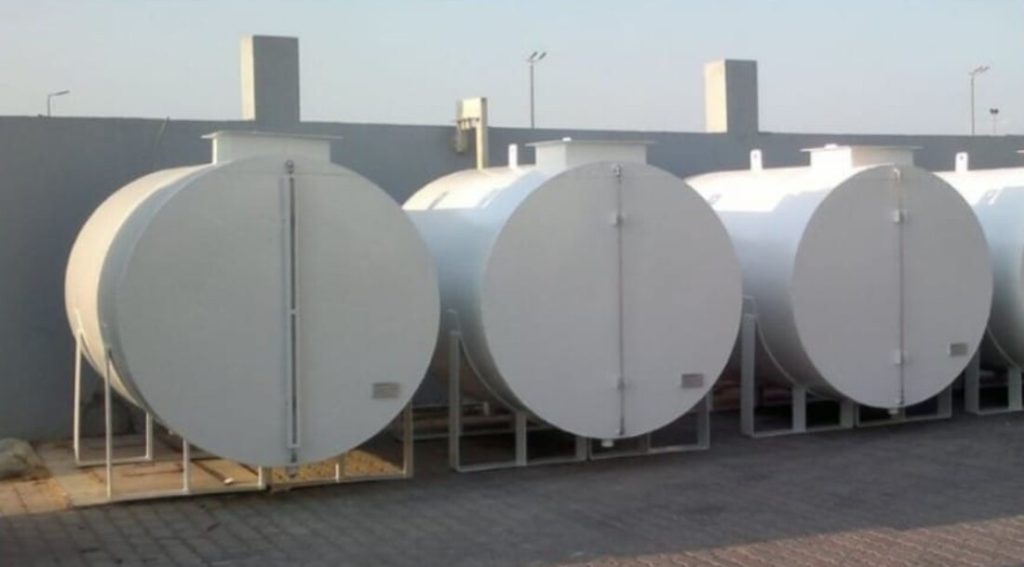
Horizontal tanks on saddles suit smaller volumes and tight footprints. Vertical suits volume per square metre of floor.
Detail
Shell, bottom and roof plates, nozzles, manholes, flanges and valves, vent and overflow pipes, drain systems, ladders, platforms, handrails and supports. Access steelwork is covered on our tank platforms and access structures page. Foundations are checked before erection, because settlement damages a tank floor faster than corrosion does.
Standards
External protection starts with surface preparation, not paint. Blasting to Sa 2.5 under ISO 8501-1 leaves at least about 95 percent of each area free of visible mill scale, rust and old coating. Most premature coating failure traces back to this step rather than to the coating itself.
Coastal sites at Port Qasim and Keamari need a heavier system than an inland tank at Faisalabad. For galvanized components, ISO 1461 sets the requirements for hot dip galvanized coatings.
Internal lining is chosen against the contents. Cathodic protection is worth considering on tank floors, since bottom side corrosion is the failure that spills product.
Process
1. Capacity and contents review. Volume, contents, concentration, temperature, operating pressure and location.
2. Material and thickness selection. Grade chosen for the contents, thickness for the head of liquid plus corrosion allowance.
3. Design. Shell courses, roof type, nozzle schedule and foundation loads.
4. Fabrication. Shell, bottom and roof, shop built where transport allows.
5. Site erection. Foundation check, then build up course by course with welds inspected as work proceeds.
6. Testing and inspection. Hydrostatic test and weld examination before handover, with records issued to you.
Questions
Small day tanks up to large field erected tanks. The practical break point is transport. Once the diameter exceeds what a trailer can carry to your site, the tank is built on the foundation instead of in the workshop.
It depends on the chemical, its concentration and its temperature, not on the word chemical. Some duties suit lined mild steel, some need a specific stainless grade, and some need a plastic lining over steel. Send the product data sheet and we will specify against it.
Both. Shop building gives better weld conditions and faster completion. Field erection is used when size or access rules out delivery in one piece.
Yes. Surface preparation to a specified blast grade, external coating chosen for the location, internal lining chosen for the contents, and cathodic protection where the floor justifies it.
Yes. API 653 is the reference standard for in service inspection, repair and reconstruction of aboveground tanks. It sets an external visual inspection interval with a five year maximum, and an internal inspection normally starting around ten years from commissioning, with later intervals calculated from measured corrosion rates.
Damp patches on the outside of the bottom course, settlement of the foundation ring, coating breakdown at the shell to floor joint and any product smell near the base. Those are reasons to inspect now rather than at the next scheduled date.
Next Step
Send capacity, contents, orientation, operating pressure and site location. Include the access route if the tank is large. We reply with a specification and a schedule.
This page sits under our steel fabrication services range.