
Double Girder EOT
We design, fabricate and install double girder overhead cranes for heavy duty lifting up to 100 tons and above. Custom EOT crane systems for steel mills, foundries, power plants and heavy engineering works across Pakistan.
1 to 100+ Tons
Capacity Range
Built In-House
Own Workshop
Nationwide
Survey & Erection
Load Tested
Certified at Handover
The Challenge
A crane that is working near its limit does not usually fail in one go. It tells you first. The hook creeps when the brake should hold it. The bridge bounces when the trolley stops. Wheel flanges wear on one side only. Operators start slowing down before every stop because the load swings.
By the time a plant calls us, those signs have usually been present for a year.
1. The girder sags visibly under load. Deflection limits are strict for a reason. CMAA rules for multiple girder cranes hold vertical deflection from the hoist, trolley and rated load to 1/888 of the span. On a 20 metre span, that is about 22 millimetres. If you can see the beam move, something is wrong.
2. Brakes and motors are being replaced often. Components sized for light service wear out fast under heavy service.
3. Wheels wear unevenly or climb the rail. Often a squaring or runway alignment problem that gets worse as loads increase.
4. You cannot lift high enough. On a one-beam machine, the hoist hangs below the girder, so hook height is capped by the building.
5. Loads are handled close to capacity all shift. This is duty, not tonnage, and it is the most common specification error in Pakistan.
Two cranes rated 20 tons can be built to completely different service classes. CMAA sets six of them, and they describe how hard the machine works rather than what it lifts. Class A is standby service with long idle periods, Class C is moderate work in machine shops, Class D is frequent high speed lifting in foundries and steel plants, Class E is continuous lifting near rated capacity, and Class F is constant operation at or near capacity in critical production.
Class C handles loads averaging half of capacity at five to ten lifts an hour. A billet handling crane in a re rolling mill in Gujranwala can pass that in ninety minutes.
The duty cycle calculation sits in Table 2.8-1 of CMAA Specification No. 70, which covers top running bridge and gantry type multiple girder cranes. ISO 4301-1:2016 does the same job with groups A1 to A8, using working cycles across the design life and the load spectrum factor.
Specify Class C steel for Class E work and the machine will lift the load on day one and crack a weld in year three.
What We Supply
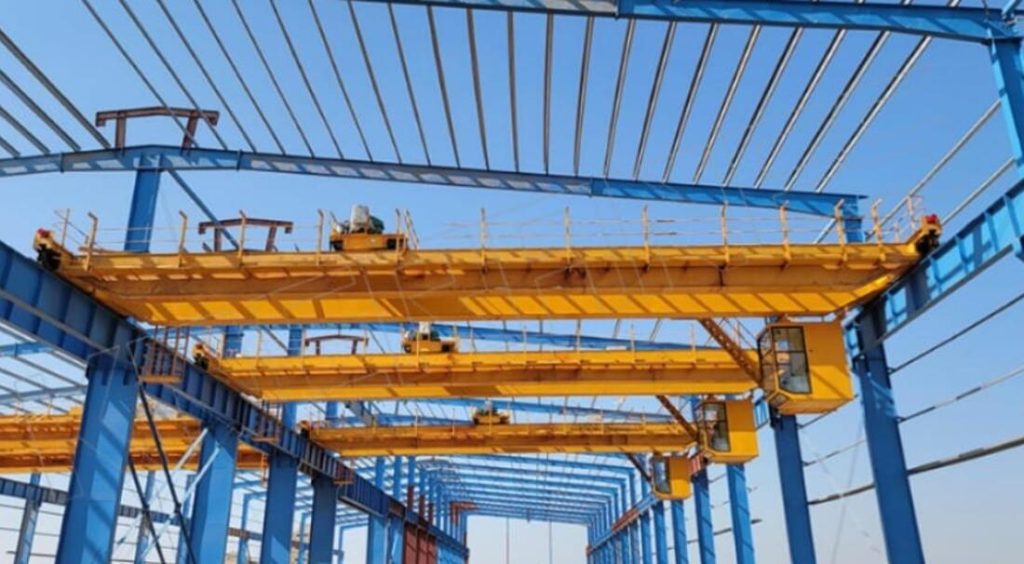
Two main girders carry the trolley on rails laid on top of the beams rather than hanging beneath them. That single change does two things.
The load path improves, so the structure takes more weight over longer spans. And the hook rises, because the hoist now sits above the girders instead of below. In a shed where roof height is fixed, this is often several feet of extra lift you cannot get any other way.
Compare against the single girder overhead crane page if your loads are under about 20 tons.
At this size the crane needs servicing at height, and a two girder bridge can carry a walkway between the beams.
That means the electrician reaches the panel, festoon and collectors from a platform instead of a ladder and a shutdown. In a plant running two shifts, access is the difference between a two hour job and a two day one.
Main girders, end carriages, wheels and the crane trolley are fabricated and machined by us. The drive is a wire rope hoist with hook block, motors, gearboxes and brakes. Electrical work covers panels, the festoon system and radio remote control.
Runway beams matter more at this capacity than anything else on the list, because wheel loads rise with tonnage and get transferred straight into your building columns. See crane runway rail track for that scope. Wearing items are on the double girder crane spare parts page.
How It Works
1. Client and sector. [To confirm]
2. Location. [To confirm]
3. Capacity and span. 20 tons, [span] metres.
4. Lifting height and duty class. [To confirm]
5. What made the job difficult. [Existing building, restricted headroom, runway condition, shutdown window]
6. Build and installation time. [To confirm]
7. Result. [To confirm]
Detail
1. Load and duty analysis. Heaviest load, lifts per hour, how close each lift sits to capacity, and the working environment.
2. Main girder structural design. Section, plate thickness and weld detail sized against strength and deflection together.
3. Fabrication and machining. Girders, end carriages, wheels and trolley made in our workshop.
4. Runway beam check. Wheel loads calculated and your existing columns and beams assessed before anything is erected.
5. Site erection. Runway alignment and squaring first, then bridge lift, trolley fitting and electrical connection.
6. Load testing and certification. Safe working load proved and marked, with the test record handed to you.
After handover, Section 33 of the Factories Act 1934 requires the crane to be thoroughly examined by a competent person at least once every twelve months, with a register of examinations kept and the safe working load plainly marked on the machine.
Questions
Up to 100 tons and above. Past a certain point the limiting factor stops being the crane and becomes your building, because wheel loads have to pass into columns and foundations that were sized years ago. We check that before quoting.
Higher capacity, longer span, greater hook height and the option of a maintenance walkway. For the same tonnage a one beam machine is cheaper to buy, so the honest answer is that you choose two girders when capacity, span, hook height or duty pushes past what one beam can carry economically.
It depends on your roof steel, not the crane. Because the trolley sits on top of the girders, hook height is usually higher than a one beam machine in the same building. Send roof height and truss detail and we will calculate it.
Yes. These are Class D and above applications with heat, dust and near capacity lifting. The most demanding steel mill duty is covered by a separate standard, the Association of Iron and Steel Engineers specification for electric overhead traveling cranes in steel mill service.
Continuous work near rated capacity is Class E or Class F under CMAA, or the upper A groups under ISO 4301-1. Tell us lifts per hour and the average load as a percentage of capacity, and the class follows from that rather than from guesswork.
It depends on capacity, span and whether the runway exists. A new runway on existing columns adds structural work before erection can start. We give a dated schedule with the quotation.
Next Step
Send capacity, span, lifting height, lifts per hour, average load and building type. Free engineering site survey anywhere in Pakistan, including a runway and column assessment.
This page sits under our main overhead cranes range.