
Gantry Cranes
Gantry crane suppliers in Pakistan for yards and outdoor lifting. Full gantry, semi gantry and portable machines fabricated in our workshop and installed nationwide, with rail laying and load testing.
1 to 100+ Tons
Capacity Range
Built In-House
Own Workshop
Nationwide
Survey & Erection
Load Tested
Certified at Handover
The Challenge
The machine stands on its own legs. That is the whole point of it. Where an overhead crane needs a building with columns strong enough to carry a runway, a gantry brings its own structure and puts the load into the ground.
Buyers often ask us for an overhead crane in an open yard, then discover what has to be built first.
An overhead crane needs runway beams. Runway beams need columns. Columns need foundations sized for the wheel loads. In a yard with no building, you are paying for a structure whose only job is to hold up a crane. On a wide span that steel and concrete can cost more than the crane.
A gantry skips all of it. The legs are part of the machine, and the load goes into a rail and a foundation beam at ground level.
Precast plants, steel yards, pipe and pole stores, container handling at Port Qasim and the shipbreaking yards at Gadani share one problem. The load is heavy, the area is open, and a forklift cannot reach it or cannot lift it.
A yard crane covers a defined rectangle repeatedly and predictably. Once the rail is laid, the working area is fixed and every lift happens the same way, which is safer than a mobile machine repositioning on soft ground.
What We Supply
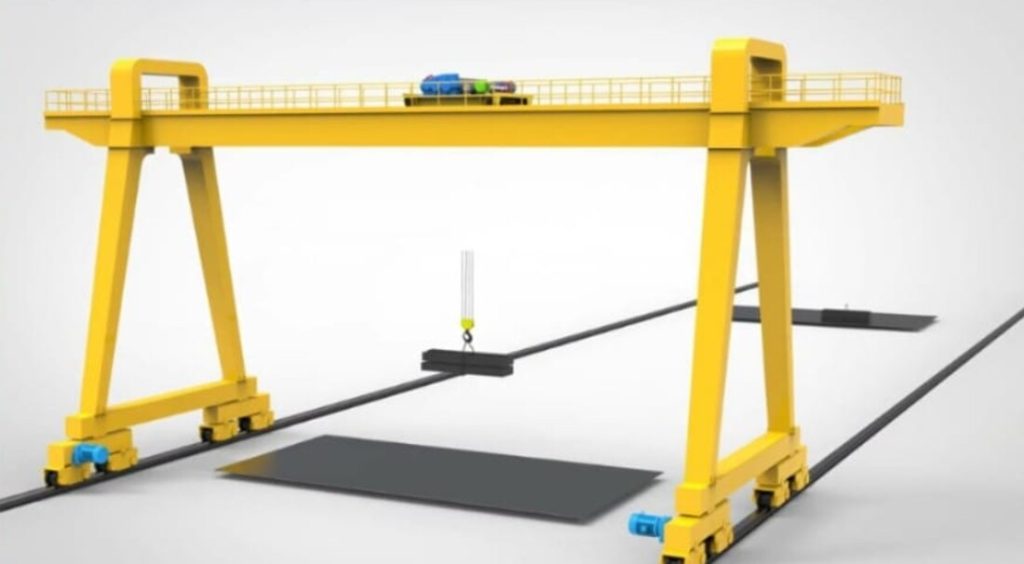
The machine carries its own structure at both ends, so it needs nothing from your buildings. That makes it the answer for an open plot, a yard between two sheds, or any area where the surrounding steel was never designed to hold a crane up. At the largest sizes, in shipyards and heavy fabrication bays, the same arrangement is called a goliath.
Half the support comes from a building you already own, half from a single leg out in the yard. The reason to want one is coverage: the hook reaches inside the shed and out onto the open ground in the same travel, so material does not get set down and picked up again at the door. The reason you may not get one is that the shed columns have to be checked first, and older sheds often cannot take it.
Light capacity machines on castors or wheels for workshops and maintenance points, moved to the job rather than the job moved to them. Good for engine removal, machine installation and shutdown work.
The same choice as inside a building, but span usually decides it out here, because yard spans run wider than indoor ones. One girder is lighter and cheaper. Two take more span and give higher hook position.
Weather changes the design, which is covered below. For covered yards we also fit shed gantry installations inside prefabricated buildings.
How It Works
Gantry legs, main girder, end carriages, trolley, hoist, wheels, cross travel and long travel mechanisms, electrical control system and limit switches.
The rail system is the part buyers underestimate. Rail sits on a foundation beam, and the beam has to be designed for the wheel loads and for your ground conditions. On made up ground or a yard that floods in monsoon, settlement puts the rails out of level, the crane starts to skew as it travels, and wheel flanges wear on one side. Correcting that later means lifting and relaying rail.
Get the ground investigated before the rail is designed. Details are on our gantry crane rail track page, and wearing items are on gantry crane spare parts.
Detail
An outdoor machine is designed twice. Once for lifting, and once for standing still in a storm.
ISO 4302:2016 covers wind load assessment for cranes. It sets out methods for both in service and out of service conditions, feeds into the load combinations of ISO 8686-1, includes allowances for gusting and dynamic response, and gives guidance on when the crane must be secured for out of service conditions.
Two figures come out of that. In service wind is the maximum the crane can work in. Out of service wind is the storm it must survive when parked, from the least favourable direction, and it is measured at the highest point of the machine.
The important part is what sits between them. The in service figure assumes the crane can be fully secured before the design wind speed is exceeded. That means someone has to notice the wind rising and act in time. Wind force rises with the square of speed, so a wind that doubles applies roughly four times the force. A dust storm building over Nooriabad or the Thal does not give much warning.
So an outdoor machine needs the securing equipment fitted and working, not listed on a drawing. Rail clamps that grip the rail, storm anchors or locking pins at defined park positions, and an anemometer with an alarm so the operator knows before the sky tells him. Ask any supplier what happens to their crane in a storm and whether the anchors are spring set to hold on power failure.
Dust and heat matter too. Sealed bearings, protected festoon or cable systems, panels rated for the environment and coatings chosen for the site. A machine at Gadani or Port Qasim sits in salt air and needs a heavier coating system than the same crane in Sheikhupura.
Foundations and legs are also designed against the wind and seismic provisions of the Building Code of Pakistan, which divides the country into five seismic zones. Confirm the zone for your site rather than reusing a design from another yard.
Standards
1. Site and ground survey. Yard dimensions, ground conditions, drainage, power supply and the loads you handle.
2. Rail mounted or wheeled. Fixed rail for repeated work in a defined area, wheels or castors for light portable machines.
3. Span and leg height design. Span set by the working area, leg height by the tallest load plus clearance.
4. Fabrication. Girder, legs, end carriages and wheels made in our workshop.
5. Rail laying and installation. Foundation beam checked, rail laid and aligned, then the machine erected on it.
6. Load test. Safe working load proved and marked, with the test record issued to you.
After handover, Section 33 of the Factories Act 1934 requires thorough examination by a competent person at least every twelve months with a register kept, and the safe working load marked on the machine. Yard operations also fall under the Punjab Occupational Safety and Health Act 2019.
Questions
Count the legs, then ask what holds up the other side. The full version supports itself at both ends and owes your buildings nothing. The half version leans on a shed along one edge of the yard and stands on a single leg at the other. So the real question is whether you own a wall worth borrowing. If its columns check out, you save a rail line, a foundation beam and a set of legs. If they do not, you are back to a full machine.
Yes, if they are specified for it. That means wind load assessment for both working and storm conditions, rail clamps or anchors, an anemometer, sealed and protected electrics, and a coating system chosen for the site. A machine designed for indoor use will not survive a yard.
For anything other than a light portable machine, yes, along with a foundation beam under it. The rail is not an accessory. Poor rail support is the most common cause of skewing and uneven wheel wear on yard cranes.
From light portable machines up to heavy yard and goliath machines. Capacity, span and duty are decided together, since a wide span at high capacity changes the whole structure. Send all three figures.
Yes, for lower capacities. They move to the job and need no rail, which suits maintenance bays and machine installation work.
Duty describes how hard the crane works, not what it lifts. ISO 4301-1:2016 groups cranes from A1 to A8 using working cycles across the design life and the load spectrum factor. Tell us lifts per shift and average load as a percentage of capacity.
Next Step
Send span, capacity, lifting height, indoor or outdoor, and whether the machine runs on rail or wheels. Include ground conditions if the yard is unpaved.
This page sits under our main overhead cranes range.