
Single Girder EOT
We build single girder overhead cranes to your span, capacity and duty cycle. Economical EOT crane systems for workshops, warehouses and light manufacturing sheds across Pakistan, with installation and load testing.
1 to 100+ Tons
Capacity Range
Built In-House
Own Workshop
Nationwide
Survey & Erection
Load Tested
Certified at Handover
The Challenge
Most factory sheds in Pakistan do not need a heavy crane. A fan unit in Gujranwala, a cutlery works in Wazirabad or a fabrication shop in Daska is lifting the same range of loads every day, a few times a shift, well inside the building it already owns. For that job, one bridge beam is the right machine and two is money spent for nothing.
The difficulty is that both types get quoted as “an EOT crane” and buyers cannot see the difference until the steel arrives.
One girder means less steel in the bridge, lighter end carriages, lower wheel loads and a lighter runway. That saving carries through the whole job, because the building columns and runway beams are sized for the crane, not the other way round.
Below about 5 tons, a single girder machine is almost always the answer. Between 5 and 20 tons it depends on span, hook height and how hard the crane will work. Above roughly 20 tons, or where you need to lift close to the roof steel, two girders usually win.
1. Usual capacity. One girder: up to about 20 tons. Double girder: 20 tons and above.
2. Hook height. One girder: lower, with the hoist hanging below the beam. Double girder: higher, with the trolley sitting on top.
3. Bridge weight. One girder is lighter; double girder is heavier.
4. Runway and column load. One girder has lower loads; double girder has higher loads.
5. Maintenance access. One girder is accessed from the floor or platform; double girder can have a walkway on the bridge.
6. Typical use. One girder suits workshops, warehouses and assembly bays. Double girder suits steel plants, foundries and heavy machining.
Headroom is the gap between the top of your highest load and the underside of the roof truss. In older sheds in Kot Lakhpat or SITE Karachi that gap is small, and it decides everything.
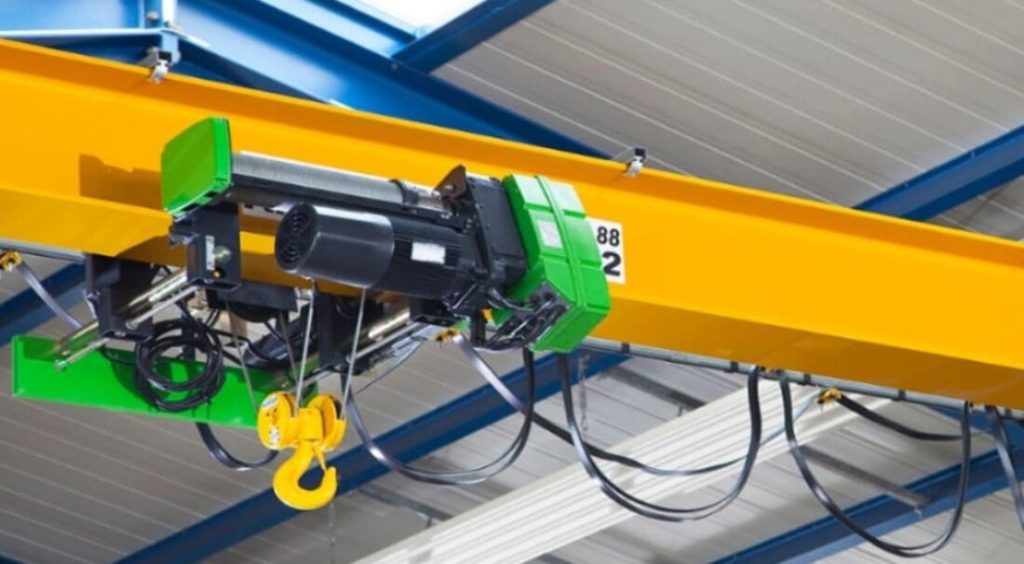
A single girder crane carries the hoist on a trolley that runs along the bottom flange of the bridge beam. The hook hangs below the girder, so the machine sits lower in the building. Where the roof is tight, this is often the only design that fits without cutting into the structure.
Hook approach is the related figure. It is how close the hook can get to the runway on each side, and it decides how much of your floor the crane can actually serve. Ask for it in writing on both sides before you sign a quotation.
What We Supply
These machines are covered by CMAA Specification No. 74, which sets out design rules for top running and under running single girder electric traveling cranes using an under running trolley hoist. The specification defines four classes of crane service to match the machine to the work, and it was last revised in 2025.
The end carriage wheels sit on rails fixed on top of the runway beams, and the runway beams sit on brackets on your building columns.
This is the stronger arrangement. Loads pass down through the columns rather than hanging off the beam flanges, so it takes more capacity and longer spans. Choose it for a new shed, for anything above roughly 10 tons, or where the crane will run all shift.
The end carriage wheels ride on the bottom flange of the runway beams, so the whole crane hangs underneath. This is also called an underhung crane.
The gain is headroom and hook approach. Because there is no rail on top and no bracket, the crane sits higher in the building and the hook reaches closer to the walls. It also lets you hang the runway from existing roof steel where there is no room for columns.
The limits are real. Capacity and span are lower, the beam flange takes bending it was not always designed for, and your building structure has to be checked before anything is hung from it. Note also that CMAA 74 does not cover monorail systems, which are a separate design.
The bridge girder, end carriages and wheels are fabricated and machined by us. The electric hoist, trolley, motors, gearboxes and brakes make up the drive. Control is by pendant or radio remote through the control panel, with limit switches at the travel ends. Wearing items are covered on our single girder crane spare parts page.
For yard work with no building to carry a runway, the same bridge design goes on legs as a single girder gantry crane.
How It Works
Give us these seven figures and you will get a comparable quotation from any supplier.
1. Lifting capacity. The heaviest load including the lifting gear, not the average.
2. Span. Rail centre to rail centre, not column face to column face. This single error causes more site rework than any other.
3. Lifting height. Floor to hook at its highest point.
4. Long travel and cross travel speed. How fast the bridge and trolley move.
5. Hoisting speed. Often two speeds, one slow for placing the load.
6. Duty class. Defines how frequently and heavily the crane will operate.
7. Runway length. How far the crane must travel down the building.
Deflection is the figure buyers never ask about. CMAA limits how far the girder is allowed to sag under the hoist, trolley and rated load, expressed as a fraction of the span, and the published clauses are strict. A beam that passes on strength can still fail on deflection, and a bouncing crane is a crane that will not place a load accurately.
Detail
1. Site and building survey. Column spacing, roof height, existing steel, power supply and floor condition.
2. Span and hook height calculation. Measured on site, not taken from a drawing that may not match what was built.
3. Duty class selection. Matched to lifts per shift and how close each lift is to capacity.
4. Fabrication. Girder, end carriages and wheels made in our workshop.
5. Runway and crane installation. Runway alignment first, then bridge erection and electrical work.
6. Load test and handover. Safe working load proved and marked, with the test record for your file.
Under Section 33 of the Factories Act 1934, the crane must then be thoroughly examined by a competent person at least once every twelve months, a register of examinations must be kept, and the safe working load must stay plainly marked on the machine.
Questions
In normal factory use, from under 1 ton up to about 20 tons. Below 5 tons it is nearly always the economical choice. Between 5 and 20 tons the decision depends on span, hook height and duty. Above that, two girders usually cost less over the life of the machine.
Longer spans need a deeper girder, which adds weight and eats headroom, so span and capacity trade against each other. Top running takes more span than under running. Send your column spacing and we will confirm what works in your shed.
For the same capacity and span, yes, and the saving continues into the runway, brackets and columns. It stops being cheaper when the job needs high hook position, heavy duty or long span, because the girder then has to grow past the point where two beams are lighter.
Duty class describes how hard the crane works, not how much it lifts. ISO 4301-1:2016 groups cranes from A1 to A8 using the number of working cycles across the design life and the load spectrum factor. A maintenance bay crane lifting twice a shift and a production crane running continuously are different machines at the same tonnage.
Often, yes. The structure has to be checked first. If the columns can take the load, a top running crane on new brackets is usual. Where they cannot, an under running crane hung from the roof steel is sometimes possible, but only after the roof structure is assessed.
Top running wheels sit on rails above the runway beams and take more load and span. Under running wheels ride under the beam flange, which saves headroom and improves hook approach but limits capacity.
Next Step
Send capacity, span, lifting height, building type and lifts per shift. Drawings or photographs of the shed help. Site survey anywhere in Pakistan.
This page sits under our main overhead cranes range.