
Rail Track
Crane rail track supply, rail track material and turntable systems for overhead and gantry machines. Survey, rail section selection, fixings, laying, alignment and verification across Pakistan.
1 to 100+ Tons
Capacity Range
Built In-House
Own Workshop
Nationwide
Survey & Erection
Load Tested
Certified at Handover
The Challenge
The crane gets the attention and the budget. The two steel lines it runs on get neither, and that is where most travel problems begin.
A crane whose wheels are square to a straight track rolls. A crane on a track that has drifted out of line does not roll, it scrubs.
You see it before you measure it. Flanges polished bright on one side only. A bridge that pulls toward one rail and has to be nudged straight. Wheels replaced every eighteen months on a machine that should run for years. Travel motors drawing more current than they used to and tripping in summer.
None of that is a crane fault, and replacing the wheels fixes nothing. The wheels are being destroyed by the track.
There is a second cost people miss. Skewing pushes sideways on the runway beams and into your building columns, which were sized for vertical load. That damage accumulates quietly.
Rail is chosen against the wheel load and the wheel itself, not against the crane’s tonnage.
Too light a section and the rail head spreads and wears. Too heavy and you have paid for steel and made the fixing harder than it needed to be. The rail head width also has to suit the wheel tread, because a mismatch concentrates contact on a narrow band and wears both parts.
Send the wheel load and the wheel dimensions. Tonnage alone is not enough to specify rail.
What We Supply
Crane rail sections and standard rail sections, selected against wheel load, wheel tread width and duty. We supply the rail and the fixings as one package so nothing arrives mismatched.
Adjustable clips let the rail be corrected after laying, which matters because a runway is never perfect on the first pass. Elastomeric pads under the rail spread the wheel load into the beam and take some of the impact out of every joint.
Joints are where runways fail. A vertical step at a joint hammers the wheel on every pass, and the impact travels into the bearings and the beam. Welded joints remove the problem where the layout allows them.
Beams, brackets and supports, covered in more depth on our crane support structures page. Beams need checking whenever capacity or duty increases, because wheel loads rise with both.
How It Works
Alignment is not a matter of looking down the rail. ISO 12488-1 sets tolerances for crane wheels and travel and traversing tracks, with four tolerance classes chosen mainly on how much total travel the crane will do across its life.
Five things get measured. Span between rail centres at every point along the run. Horizontal straightness, both across the whole length and locally over a two metre check. Vertical straightness, again over the full length and locally. Cross level, meaning the height of one rail relative to the other at the same station. And the joints, for step and gap.
The class sets the numbers. On vertical straightness, for example, the permitted deviation of the rail centre height runs from about five millimetres in the tightest class out to forty in the loosest, with the local two metre check tightening to a single millimetre at the top class. Cross level is expressed against span, so a wider runway is allowed proportionally more, up to a fixed ceiling.
The practical point for a buyer: ask which class your runway was built to. Most people have never been told, and a runway laid to a loose class under a crane that runs all shift will wear exactly as described above.
Detail
This one catches surveys in Pakistan specifically.
The tolerances in the standard are referenced to an ambient temperature of twenty degrees Celsius, and adjustment is required when the working temperature differs.
Steel expands roughly twelve micrometres per metre for every degree. On a hundred metre runway, the difference between a twenty degree morning and a forty five degree afternoon in Multan or Sukkur works out around thirty millimetres of length change. That is not a rounding error, and it is why expansion gaps at joints have to be calculated against your local temperature range rather than copied from a drawing made elsewhere.
It is also why a survey should record the temperature it was taken at. A runway measured at midday in June and a runway measured at dawn in January are not the same runway on paper.
Standards
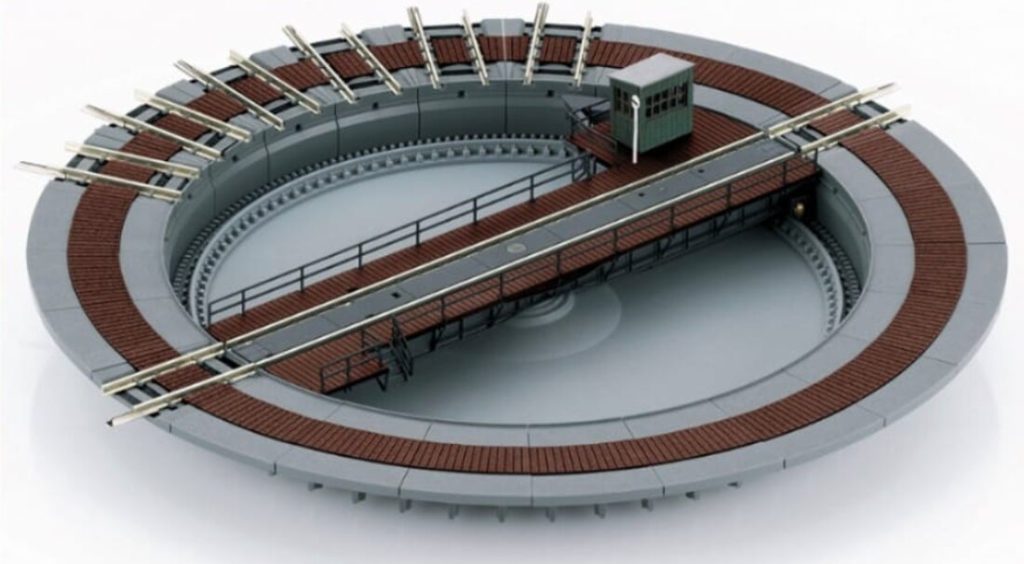
A turntable carries a load or a vehicle on a rotating platform so it can change direction where there is no room for a curve. Platform, rotation mechanism, drive motor, gearbox, bearings and limit switches make up the assembly.
The platform has to stop with its rails lined up to the fixed track, and lock there before anything crosses. Positioning and locking are the parts that decide whether the installation is usable, not the rotation itself.
This is where turntables earn their keep in Pakistan. Locomotive and carriage workshops, including the works at Mughalpura in Lahore, need to move stock between parallel bays inside a building where laying curves is impossible.
Heavy engineering plants use the same idea to index large fabrications between welding and machining stations without craning them off the track.
Process
1. Survey and alignment check. Existing runway measured against the tolerance class, with temperature recorded.
2. Rail section selection. Chosen on wheel load and wheel dimensions.
3. Supply. Rail, clips, pads and joint hardware together.
4. Laying and alignment. Set, then corrected on adjustable fixings.
5. Turntable installation. Where the scope includes one.
6. Verification. Final measurements documented and handed to you.
That record matters later. Under Section 33 of the Factories Act 1934 the crane needs thorough examination by a competent person at least every twelve months with a register kept, and runway condition is part of what that examination looks at. Site work also falls under the Punjab Occupational Safety and Health Act 2019.
Detail
Send crane capacity, wheel load if known, runway length, and whether the runway is existing or new.
Related pages: overhead cranes, gantry cranes and monorail crane systems.
Questions
Crane rail and standard rail sections, specified against your wheel load and wheel tread rather than against crane tonnage. Send the wheel data and we will confirm the section.
Because a crane that is not square to a straight track scrubs instead of rolling. That destroys wheels and flanges, raises travel current, and pushes sideways loads into beams and columns that were designed for vertical load.
Changing direction where a curve will not fit. Railway workshops moving stock between parallel bays are the main use, along with plants that index heavy fabrications between workstations.
Yes. We measure span, straightness in both planes, cross level and joints against the applicable tolerance class, record the temperature, and give you a report with the numbers rather than an opinion.
Yes, along with turntables and the positioning and locking arrangements that go with them.
Usually not. One sided flange wear is the classic sign of a track that is out of alignment or a bridge running out of square. Survey the runway before buying more wheels, or you will buy them again.