
Jib Cranes
Wall mounted, pillar and slewing jib cranes for workstations and machine loading. Built to your radius and capacity in our workshop and installed across Pakistan.
1 to 100+ Tons
Capacity Range
Built In-House
Own Workshop
Nationwide
Survey & Erection
Load Tested
Certified at Handover
The Challenge
Most workshops in Pakistan already have a lifting solution at the press or the lathe. It is a chain block hanging off a pipe laid across two roof members, and nobody knows what that pipe is rated for. It works until the day it does not.
A jib does the same job with a known capacity, a known radius and a load test certificate.
Two men lifting a die into a press is the most expensive lift in the building, because the cost arrives later.
Handling injuries are not rare events. The Health and Safety Executive records that handling, lifting or carrying accounted for 17 percent of employee non fatal injuries reported by employers in 2024/25, second only to slips and trips. The back takes most of it, and back injuries recur for years.
This is a legal duty here as well as a good idea. The Punjab Occupational Safety and Health Act 2019 covers the use, handling and storage of excessive weights among the matters it regulates, and places general duties on the employer for safety at the workplace.
The economics are simple. One skilled operator off work for three weeks costs more than the crane that would have prevented it.
An overhead crane serves a whole building. Runway beams down both sides, columns strong enough to carry them, and a machine that travels the length of the shed.
If the lifting all happens within a few metres of one machine, you are buying a building wide solution for a single point problem. A jib covers a circle, not a rectangle. Where the work stays inside that circle, it costs a fraction of the alternative and installs in a day.
The reverse is also true. If loads move between stations, one jib will not do it and you want overhead cranes instead.
What We Supply
Suppliers use six or seven names for what are really three arrangements. Two things separate them: what holds the crane up, and how far the arm can swing.
The arm is bracketed to a wall or a structural member. It swings about 180 degrees, because the wall occupies the other half of the circle. No floor space is used and no foundation is needed, which is the attraction.
The catch is what the wall has to take. The brackets work as a pair, the upper one pulled away from the wall and the lower one pushed into it. Brick and block walls usually cannot do this. It needs a structural column or a properly designed steel backing.
The same idea, fixed to an existing building column instead of a wall. Swing depends on what sits around the column, often 180 to 270 degrees.
Before this is quoted, the column has to be checked. It was sized to carry roof and floor load, not a sideways pull from an arm with a load on the end.
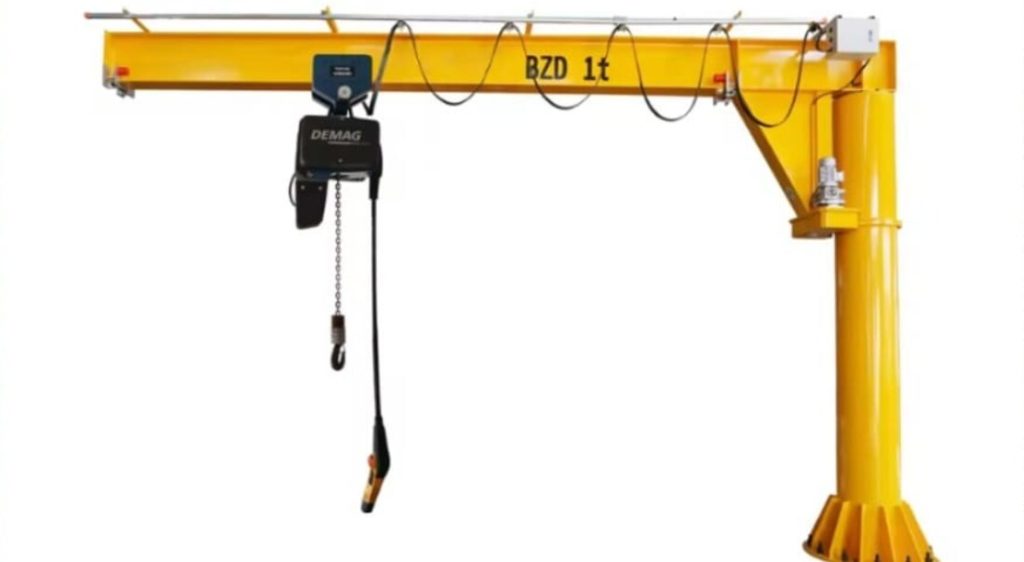
These three names describe the same machine. It has its own mast, bolted to its own foundation, standing wherever you want it.
Because nothing is beside it, the arm swings a full 360 degrees. That is the reason to choose it, along with independence from your building. The cost is a concrete foundation and the floor space the mast occupies.
The arm is made in two hinged sections. The outer section swings independently, so the hook can reach around a machine, into an enclosure or behind an obstruction instead of only along a straight line.
Choose this where the path to the load is not clear, not where you simply need reach.
How It Works
Slewing means the arm rotating about its mount. Most workstation machines slew by hand, which is fine at moderate capacity and short radius. Powered slewing is worth it at higher capacity, on long arms, or where the operator has to hold a position steady while placing a part.
Slew stops matter more than buyers expect. Without them the arm can swing into a machine, a wall or a person during the return travel. Say what is beside the crane and we will set the limits.
Detail
This is the point most buyers miss, and it is the reason two quotations for the same capacity can differ sharply.
A jib does not just carry weight. It carries weight held out at a distance, and that produces a turning force at the base. The force is capacity multiplied by radius. Half a ton held four metres out puts twice the turning force into the base as the same half ton held two metres out.
So the foundation is sized by radius as much as by capacity. Asking for extra reach because it might be useful one day is not free. It is often the single biggest cost driver on a floor mounted machine.
Deflection compounds it. Every arm bends a little under load. If it bends enough, a manual trolley will roll outward on its own toward the tip, which increases the radius, which increases the turning force again. A well designed arm keeps deflection small enough that this does not happen.
For a freestanding machine the foundation is designed against the calculated base reactions and the wind and seismic provisions of the Building Code of Pakistan, which divides the country into five seismic zones. Soil data for your site is needed before the foundation is finalised.
Standards
1. Workstation assessment. What is lifted, how heavy, how often, and what stands around the machine.
2. Radius and slew angle. Set from the actual working circle, not from a round number.
3. Foundation or wall fixing design. Base reactions calculated, then either a foundation designed against your soil or a check on the wall or column you intend to use.
4. Fabrication. Arm, mast, base plate and slewing mechanism made in our workshop.
5. Installation. Fixed, aligned and set with slew stops.
6. Load test. Safe working load proved and marked, with the certificate issued to you.
Afterwards, Section 33 of the Factories Act 1934 requires thorough examination by a competent person at least every twelve months, a register of examinations, and the safe working load kept plainly marked on the machine.
Questions
Repeated lifting inside one working circle. Loading and unloading machines, moving dies and tooling, feeding an assembly station, and lifting at maintenance points. It replaces the two man lift and the chain block on an unrated pipe.
Ask what you have and what you need. If a structural column or a strong wall sits where you want the crane and half a circle of swing is enough, the wall type saves you a foundation and your floor space. If you need full rotation, or the wall cannot take the pull, you need the pillar type and the concrete that goes with it.
Roughly 180 degrees on a wall mount, 180 to 270 on a column mount, and a full 360 on a machine with its own mast. Powered slewing is available where capacity or radius makes hand slewing hard work.
Workstation scale, from light manual units upward. Capacity and radius are decided together, because reach drives the structure. For anything heavier than a workstation needs, look at workstation lifting equipment or a full crane instead.
Yes. The mast transfers a turning force into the ground and the foundation resists it. Size depends on capacity, radius and your soil, so we calculate the reactions and specify accordingly rather than reusing a standard block.
Duty describes how hard the machine works, not what it lifts. ISO 4301-1:2016 classifies cranes from A1 to A8 on working cycles and load spectrum. A jib feeding a production line all shift is a different machine from one used twice a day.
Next Step
Send capacity, radius, mounting type and location, plus a photograph of the workstation. Wearing items are on our jib crane spare parts page.