
Monorail Systems
Monorail cranes and monorail hoist systems for fixed path material handling. Straight and curved underhung track, designed, fabricated and installed across Pakistan.
1 to 100+ Tons
Capacity Range
Built In-House
Own Workshop
Nationwide
Survey & Erection
Load Tested
Certified at Handover
The Challenge
One beam. One path. The hoist travels along it and nowhere else.
That sounds like a limitation until you look at what most production lines actually do, which is move the same thing from the same place to the same place, several hundred times a week.
Watch a line for an hour and count how many times two people carry something between the same two points. Dyeing beams in a Faisalabad textile unit. Carcasses down a poultry processing line. Castings from the pouring floor to the knockout station. Panels between paint booth and assembly at the plants around Port Qasim.
Each of those is one path, repeated. The load never needs to go sideways. Paying for a machine that can reach anywhere in the building is paying for freedom the job does not use.
An overhead crane covers a rectangle. It travels the length of the shed on runway beams and the trolley crosses the width, so the hook reaches any point on the floor.
That costs two runway beams, building columns strong enough to carry them, and a bridge spanning the whole width. A single beam on hangers costs a fraction of it.
The question is whether your route changes. If it does, you want overhead cranes. If it does not, a fixed beam does the same work for less money and installs faster.
What We Supply
A beam running a defined route, hung from roof steel or carried on its own supports. The simplest and cheapest arrangement, and the right answer for a transfer between two fixed points.
The beam bends to follow the line rather than the line bending to follow the beam. This is what lets the route go around a column, turn into a bay, or follow the shape of a process.
Curves have a minimum radius set by the trolley and the track section, so the layout has to be designed with the hardware in mind. Send us the floor plan, not just the two end points.
Where two routes meet, a switch moves the carrier from one beam to another. Interlocks make sure the two beams are lined up and locked before the trolley crosses the joint.
These are covered by the same standard as the rest of the system. ASME B30.11 applies to underhung crane and monorail systems and their track sections, including curves, switches, transfer devices, and lift and drop sections, for both powered and hand operated equipment.
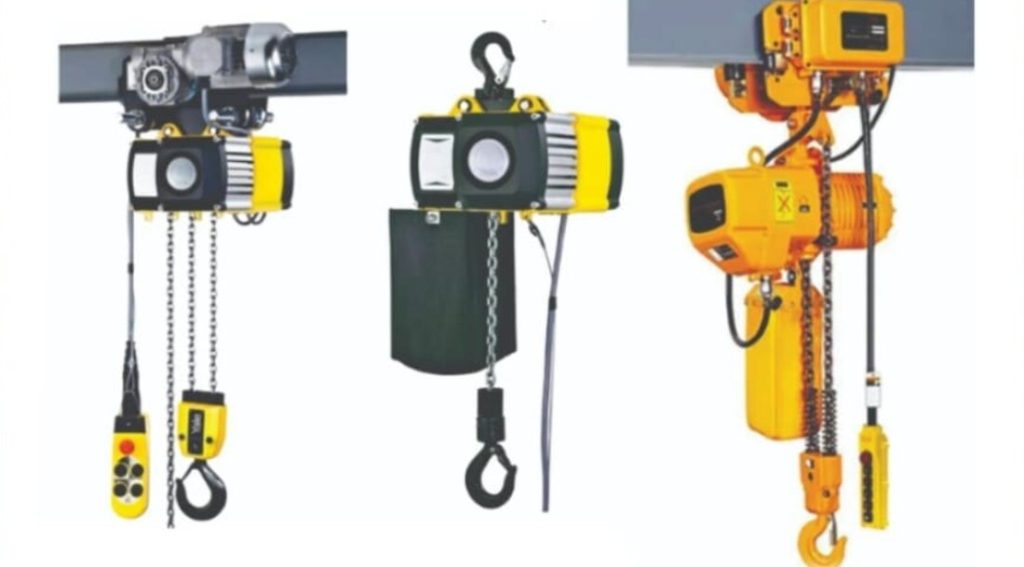
How It Works
Three kinds of beam get sold as monorail track, and they are not interchangeable.
Standard rolled beam. An ordinary structural section with the trolley running on the lower flange. Cheapest, widely available in Pakistan, and repairable by any fabricator. The flange is not hardened, so at high duty the running surface wears.
Patented track. A section made for the job, with a hardened lower flange that resists wear and a shape matched to the trolley wheel. Covered by ANSI MH27.1, published by the Monorail Manufacturers Association. Better rolling resistance and longer life at high cycle rates.
Enclosed track. The trolley runs inside the section, which keeps dust and dirt off the running surface. Covered by MH27.2. Suited to clean areas and to plants where airborne dust is constant.
One detail worth knowing whichever you choose. At a track joint, the standard limits the gap between the ends of the load carrying flange to about one sixteenth of an inch, which is roughly 1.5 millimetres. Anything wider and the trolley wheel drops into it on every pass. That is what makes an old system rattle and what wears out wheels. If you have an existing line that has become rough, measure the joints before you replace the trolleys.
Track sits alongside our crane rail and track systems work, which covers runway rail for bridge and gantry machines.
Detail
1. Coverage. Fixed beam system: one defined route. Bridge crane: the whole floor area.
2. Structure needed. Fixed beam system: hangers or light supports. Bridge crane: two runways plus columns.
3. Route flexibility. Fixed beam system: fixed, or switched between set routes. Bridge crane: any point in the bay.
4. Typical cost. Fixed beam system: lower. Bridge crane: higher.
5. Best for. Fixed beam system: repeated transfer along a known path. Bridge crane: varied work across a building.
Standards
This catches buyers out, so it is worth stating plainly.
The monorail specification covers the crane and monorail equipment. It does not cover the design of the building, the design of the supporting structure, the electrical power supply, or erection.
In practice that means a supplier can deliver a fully compliant system and still leave you with a problem, because the roof steel it hangs from is nobody’s responsibility unless somebody makes it theirs. An underhung system pulls down on your existing structure at every hanger point, and older sheds in Pakistan were rarely designed with that in mind.
We check the supporting structure before quoting, and we say so in writing. Ask any other supplier the same question before you sign.
Process
1. Route and layout survey. The actual path, the obstructions, the roof steel above it and the working height below.
2. Beam and track design. Section, spans between hangers, curve radii and any switches.
3. Hoist selection. Capacity, lift height, speeds and duty.
4. Fabrication. Beam, hangers, supports and stops made in our workshop.
5. Installation. Hung, aligned and levelled, with end stops fitted.
6. Testing. Safe working load proved and marked, with the record handed over.
After that, Section 33 of the Factories Act 1934 requires thorough examination by a competent person at least every twelve months, a register of examinations, and the safe working load kept marked on the equipment.
Detail
Send the route length, the load, the lift height, and whether the path is straight or needs curves and switches. A floor plan or photographs help.
Wearing items are covered on our hoist and monorail spare parts page.
Questions
A hoist and trolley running along one fixed beam, with the trolley riding the lower flange. It moves loads along a set route rather than across an area, which is why it suits production lines and transfer points.
Yes, and curves are one of the main reasons to choose this over a bridge crane. Radius is limited by the trolley and the track section, so the layout and the hardware are designed together.
Coverage. A bridge crane reaches any point in a rectangle because the trolley crosses a travelling bridge. A single beam reaches only the points along its own route. You are trading area coverage for a much lighter structure and a lower price.
From light chain hoists up to wire rope units. Capacity is limited by the beam and by what your roof structure can carry, which is usually the tighter of the two constraints in an existing building.
Yes, using switches and interlocked transfer sections so a carrier moves between routes. Tell us both areas and the route between them, and whether the load must cross an aisle.
Often, but the roof steel decides. Every hanger applies load to your structure, so we survey and check it before design. If the structure cannot take it, floor supported posts are the alternative.