
Hazardous Area
Explosion proof cranes and hoists for hazardous areas in oil, gas, chemical and paint plants. Flameproof and spark resistant lifting systems engineered to the zone classification of your site.
Rated Design
To Threat Level
Built In-House
Own Workshop
Nationwide
Supply & Install
Documented
Handover Records
The Challenge
Every other crane on this site is specified around load and duty. This one is specified around ignition.
A normal crane is full of ignition sources, and most of them are not obvious.
The motor and control panel arc when they switch. Brakes and wheels heat under friction. A hoist that stalls draws current and gets hot. Steel striking steel throws sparks, whether that is a hook against a vessel or a wheel flange climbing a rail. Static builds on a moving load and discharges.
Any one of those is harmless in a workshop and fatal in a solvent store.
The last one catches people out. A paint plant does not need a leak to have an explosive atmosphere. Vapour above an open mixing vessel is enough, and vapour is heavier than air, so it collects at floor level where nobody is looking.
Classifying the area is not the crane supplier’s job. It is the duty of the site operator, carried out by a competent person, normally a process safety engineer, using IEC 60079-10-1 for explosive gas atmospheres and the dust equivalent for combustible dusts.
That study produces a zone drawing. Everything else, including this crane, follows from it. If your plant does not have one, that is the first thing to commission, not the crane.
Employer duties in Pakistan sit under the Punjab Occupational Safety and Health Act 2019, which covers the workplace generally and lifting operations specifically.
What We Supply
Bridge cranes for process bays, drum stores and reactor halls, built on our standard overhead cranes engineering with the electrical and mechanical protection changed to suit the zone.
For yards and outdoor areas where a vent, a loading point or a tank farm creates a classified zone. See explosion proof gantry cranes for the base design.
Workstation lifting at a drum filling point, a sampling station or a pump skid. Base design on our explosion proof jib cranes page.
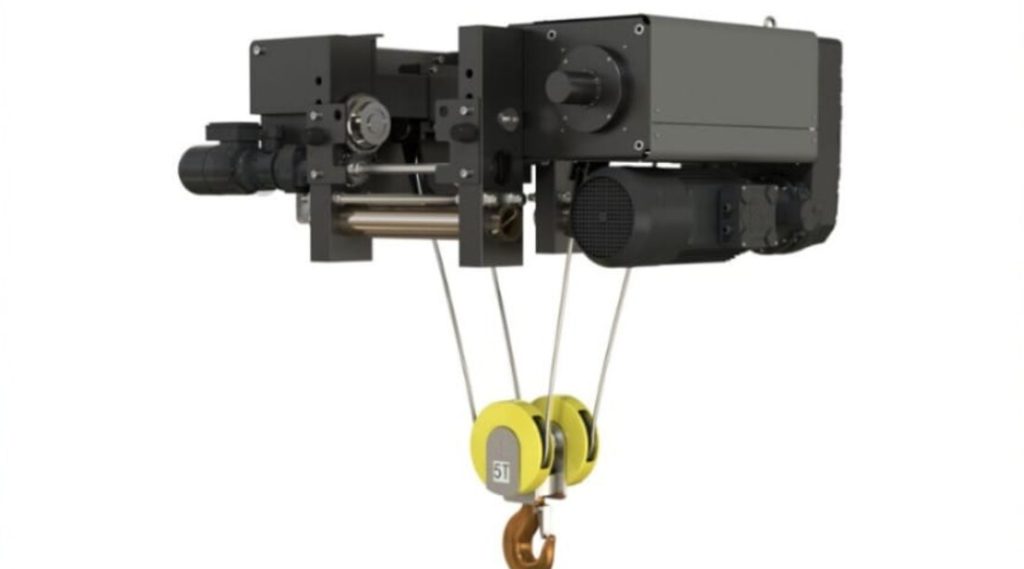
Where the structure is already there and only the lifting unit needs to change.
How It Works
1. Three gas zones. Defined by how often an explosive atmosphere is present.
2. Zone definitions. When the atmosphere is present.
3. Equipment category. Describes the fault tolerance required.
4. Protection level. Indicates how well the equipment must keep you safe.
5. Gas groups. IIA through IIC, showing how easily the gas ignites.
6. Temperature class. Caps the maximum surface temperature the equipment may reach.
Zone 0 is continuously, for long periods, or frequently. Zone 1 is likely in normal operation, occasionally. Zone 2 is unlikely in normal operation, and brief if it happens. Combustible dusts use a parallel set, Zones 20, 21 and 22, with categories 1D, 2D and 3D.
The categories describe fault tolerance. Category 1 equipment has to stay safe even when two independent faults happen together. Category 2 gives high protection during normal operation. Category 3 is safe in normal operation only, and becomes an ignition source if something fails.
Equipment rated for a more demanding zone can always be used in a less demanding one. The reverse is never true, and it is the mistake that kills people.
Two more markings matter on every component. Gas group, IIA through IIC, describes how easily the gas ignites. Temperature class caps the maximum surface temperature the equipment may reach: T1 is 450 degrees, T2 is 300, T3 is 200, T4 is 135 and T5 is 100 degrees Celsius, with T6 lower still. That figure must sit below the ignition temperature of whatever is in your air.
Detail
Protection is applied two ways, and a crane needs both.
Electrical. Motors, brakes, panels, pendant stations, limit switches and lights are replaced with certified Ex components. Flameproof enclosures contain an internal explosion instead of preventing one. Increased safety and intrinsic safety take different routes to the same end. These parts are certified by their manufacturers under the IEC 60079 series, and every one arrives with its own certificate.
Mechanical. This half gets forgotten. Non sparking materials at contact points, bronze or brass where steel would otherwise strike steel, spark resistant hook fittings, bonding and earthing so static has a path to ground, and enclosed or protected friction surfaces. Overload protection matters more here than elsewhere, because a stalled hoist is a heat source.
Standards
This is the detail we see missed most often on Pakistani sites, and it voids the protection completely.
Certified equipment is normally rated for an ambient range of about minus 20 to plus 40 degrees Celsius unless the certificate states otherwise. Read that number against a June afternoon inside a covered process area in Karachi, Multan or Kot Addu.
Once ambient goes above the certified range, the equipment is outside the conditions its certificate was issued for. The paperwork still says Ex. The protection no longer holds, because the temperature class was calculated on an assumption that is no longer true.
So the ambient rating on every certificate has to be checked against your actual site conditions, not against an average. Ask for components rated for a wider range where the plant needs it. Any supplier who has not raised this with you has not thought about your climate.
Process
1. Classification review. We start from your zone drawing and the material safety data for what is handled. If there is no classification study, that comes first.
2. Equipment selection to zone. Category, gas group, temperature class and ambient range specified for each component against the zone it will sit in.
3. Component sourcing. Certified Ex components obtained from their manufacturers, with certificates supplied to you.
4. Fabrication. The mechanical structure built and finished with non sparking measures at contact points.
5. Installation. Fitted, earthed and bonded, with the protection measures verified before energising.
6. Documentation. Component certificates, the specification they were selected against, and the load test record collected into one file for your records and your inspector.
After handover, Section 33 of the Factories Act 1934 applies as it does to any crane: thorough examination by a competent person at least every twelve months, a register of examinations, and the safe working load kept marked on the machine.
Questions
Nothing single. Certified electrical components suited to the zone, non sparking materials where parts contact, earthing and bonding against static, surface temperatures kept below the ignition temperature of the atmosphere, and overload protection so nothing stalls and heats. Remove any one and the rest stop mattering.
That comes from your own classification study, not from us. It is the site operator’s duty and it is done by a competent person against IEC 60079-10-1. We engineer to the zone your study gives us.
Yes, engineered the same way. The structure is ours, the certified Ex components come from their manufacturers with their certificates, and both are selected against your zone.
Refineries, gas processing, petrochemical and chemical plants, paint and solvent manufacturing, pharmaceutical production, and any area handling flammable liquids or combustible dusts. Grain, sugar and flour handling count, because dust explodes too.
Certificates for every certified component, showing category, gas group, temperature class and certified ambient range. The specification those parts were chosen against. The load test record. Ask for all of it in writing before ordering, from us or from anyone else.
Commission the classification study first. Buying protected equipment without knowing the zone means guessing, and guessing either wastes money on over specification or leaves you unprotected.
Next Step
Tell us the zone, the material handled, the ambient conditions and the lift. Send the classification drawing if you have one.
Sites like these often need blast proof gates for hazardous sites as well.