
Spare Parts
Crane spare parts in Pakistan for overhead, gantry, jib and monorail machines. Hoists, wheels, brakes, controls, wire rope and customized parts, dispatched nationwide.
1 to 100+ Tons
Capacity Range
Built In-House
Own Workshop
Nationwide
Survey & Erection
Load Tested
Certified at Handover
The Challenge
If your crane is stopped right now, send a photograph of the nameplate on WhatsApp and skip the rest of this page. We identify from photographs every day.
The part itself is rarely the problem. The paperwork is.
An imported component means an order placed abroad, payment arranged, shipping, then clearance at Karachi. Any one of those steps can stall, and they run in sequence, not together. Plants routinely wait a month or more for an item that took two days to manufacture.
Now put that against a sugar mill in the middle of crushing season, or a re rolling mill in Gujranwala with orders on the floor. The cost of the stoppage passes the cost of the part in the first week and keeps going.
Parts made or stocked in Pakistan remove the entire import chain.
A large share of the cranes running in Pakistani plants were built by companies that no longer trade, or imported second hand with no papers at all.
There is no catalogue to order from, no part number and often no manual. The usual result is a plant cannibalising one machine to keep another running.
We work from the part itself. A wheel can be measured and cut. A gearbox can be opened, the gears measured and new ones made. An end carriage can be rebuilt. Age is not the obstacle people assume it is.
What We Supply
Nearly every enquiry we can answer quickly starts the same way.
Photograph the nameplate on the crane and the hoist, both of them. Then photograph the worn part from two angles, with a tape measure laid alongside it for scale. If the part has any stamped numbers, get those in focus.
That is usually enough for us to identify it or make it. Where it is not, we come and measure.
How It Works
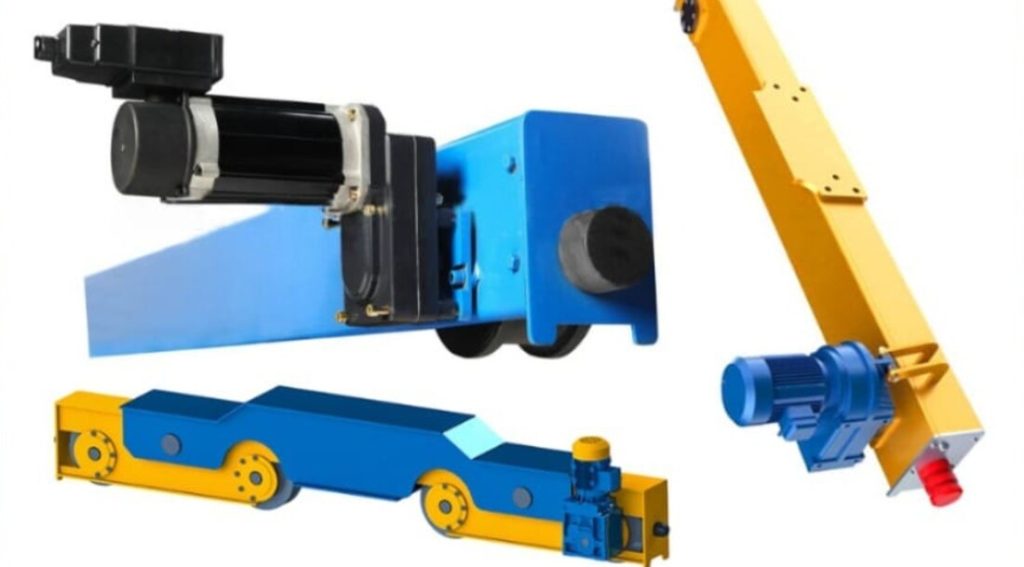
1. Travel. Crane wheels, wheel blocks, wheel assemblies, end carriages, end trucks and trolleys.
2. Drive. Motors, gearboxes, gears, pinions, shafts, couplings, bearings and bushes.
3. Lifting. Drums, sheaves, wire ropes, hooks and hook blocks.
4. Braking. Brakes, brake linings and brake wheels.
Detail
1. Control. Control panels, contactors, relays, resistors, inverters and variable frequency drives.
2. Operator. Pendant stations, push buttons and radio remote controls.
3. Power feed. Cable reels, festoon cables and trolleys, collectors and electrical connectors.
4. Sensing. Limit switches and sensors.
Standards
1. Load protection. Overload limiters and load indicators.
2. Travel protection. Crane buffers, anti-collision systems and limit switches.
3. Operator protection. Emergency stop switches, warning alarms and safety hooks.
Safety components are the ones plants defer because the crane still lifts without them. That reasoning holds right up until the day it does not.
Process
Most of the parts we supply go onto machines somebody else made.
That includes imported cranes whose supplier has left the market, locally built machines with no documentation, and equipment inherited when a plant changed hands. We do not need the original maker’s cooperation to make a wheel that fits.
We supply parts for spare parts for single girder cranes, spare parts for double girder cranes, spare parts for gantry cranes, spare parts for jib cranes, spare parts for monorail systems and spare parts for explosion proof cranes, alongside the overhead cranes we manufacture.
For explosion proof machines, note that certified components must be replaced with certified equivalents. Fitting an ordinary motor to a crane in a classified area removes the protection entirely.
Detail
Two items account for most of what we replace, and both have published criteria rather than opinions.
Wire rope. ISO 4309 covers care, maintenance, inspection and discard of steel wire ropes on cranes and hoists. It looks at visible broken wires counted over reference lengths of six and thirty rope diameters, broken wires near the terminations, diameter reduction from wear or corrosion, internal and external corrosion, deformation such as kinking, birdcaging, waviness and crushing, heat damage and loss of lubrication.
The part most people get wrong: there is no single broken wire number that means discard. The allowable count depends on the rope construction, its category number, the machine’s classification group and whether the drum is single or multi layer. Anyone quoting you one universal figure has not read the standard.
Hooks. Checked for throat opening, wear at the saddle and twist. Under ASME B30.10, distortion increasing the throat opening by five percent, or by more than a quarter of an inch, takes the hook out of service. Measure it against the original dimension, which is why recording it when the crane is new is worth doing.
These checks belong in the twelve monthly thorough examination that Section 33 of the Factories Act 1934 requires, with a register kept. Plant duties also fall under the Punjab Occupational Safety and Health Act 2019.
Detail
1. Identify the crane. Make, capacity, span and year if known. Nameplate photographs cover most of this.
2. Identify the part. Photographs from two angles with a scale, plus any stamped numbers. We confirm what it is or what it needs to be.
3. Availability and quote. Whether it is stocked, made to order, or needs measurement on site, with a time against each.
4. Dispatch. Nationwide.
5. Fitting support. Guidance by phone, or our technician on site where the job needs one.
Questions
Yes, and that is most of this work. Imported machines, locally built cranes and equipment with no paperwork. Send nameplate and part photographs and we will tell you what we can do.
Usually. When no catalogue exists we work from the worn part or from measurements taken on site, then manufacture. A discontinued crane is a manufacturing problem, not a dead end.
Yes. Non standard wheels, modified end carriages, different shaft dimensions and adapted mountings are routine, because much of what runs in Pakistan was modified at some point already.
Stocked items dispatch quickly. Manufactured items depend on the part. Either way you avoid the import chain, which is where the weeks normally go. We give a date with the quotation rather than an estimate afterwards.
Yes, all three groups above. For classified areas, certified components are replaced with certified equivalents only.
Ask what the crane does now. If duty has increased since installation, replacing like for like puts the same undersized part back. ISO 4301-1 classifies cranes from A1 to A8 on working cycles and load spectrum, and a change in how hard the machine works can justify a heavier component.
Next Step
Photographs of the nameplate and the part are enough to start. WhatsApp is fastest for breakdowns.